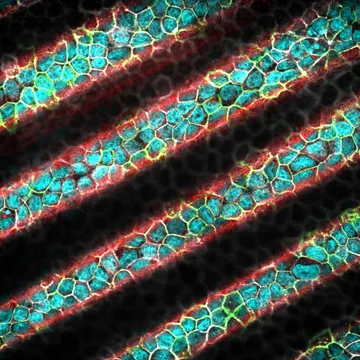
Epithelial cells on curved substrates
Epithelia line most organs, and many of them are curved. My PhD asked a deliberately narrow question: can the three-dimensional shape of an epithelial cell on a curved surface be explained by a handful of tensions, and if not, what is missing?
A minimal model
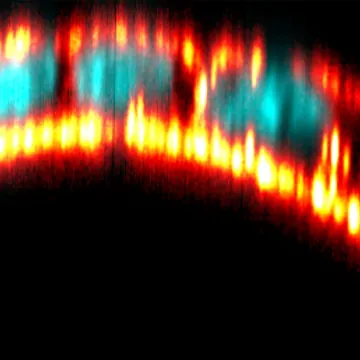
I grew epithelial monolayers on wavy substrates and measured cell thickness on the crests and in the valleys. On short wavelengths, cells are thicker in the valleys, as they are in the folding ventral furrow of the Drosophila embryo.
A foam-like model, in which each cell is described by the tensions of its faces, predicts the opposite. One extra ingredient corrects it: a line tension along the apical actin belt. Its fitted value barely changes when adhesion or myosin activity is perturbed.


Where it breaks
The model cannot explain why the effect saturates at high curvature: a term that resists flattening is missing, and the nucleus is the most likely candidate. Describing the epithelium as a continuous film leads to the same place: a passive elastic film fails, and the data require an active stress in the apical layer.
Naming that boundary is the result as much as the fit: it says which mechanism a tension-based description of epithelia has to add.
Collaborations
- Theory & modelling: J. Dervaux (MSC)
- Experimental biophysics: L.-L. Pontani (LJP), S. Hénon (MSC), C. Poulard (LPS)
Related publications
-
2022
Thickness of epithelia on wavy substrates: measurements and continuous models The European Physical Journal E 45 (6), 53 (2022)Journal cover DOI: 10.1140/epje/s10189-022-00206-1 arXiv (free version)
-
2021
3D Shape of Epithelial Cells on Curved Substrates Physical Review X 11 (3), 031028 (2021)One of the 8 papers in the PRX collection “Highlights in Experimental Statistical, Biological, and Soft-Matter Physics” (2022) DOI: 10.1103/PhysRevX.11.031028 arXiv (free version)